Looking for Pelvic Organ Prolapse Doctors Near Me? Read This First
Most women who search for this have just felt something that should not be there, and are somewhere between alarmed and embarrassed. Here is the calm version of what happens next.
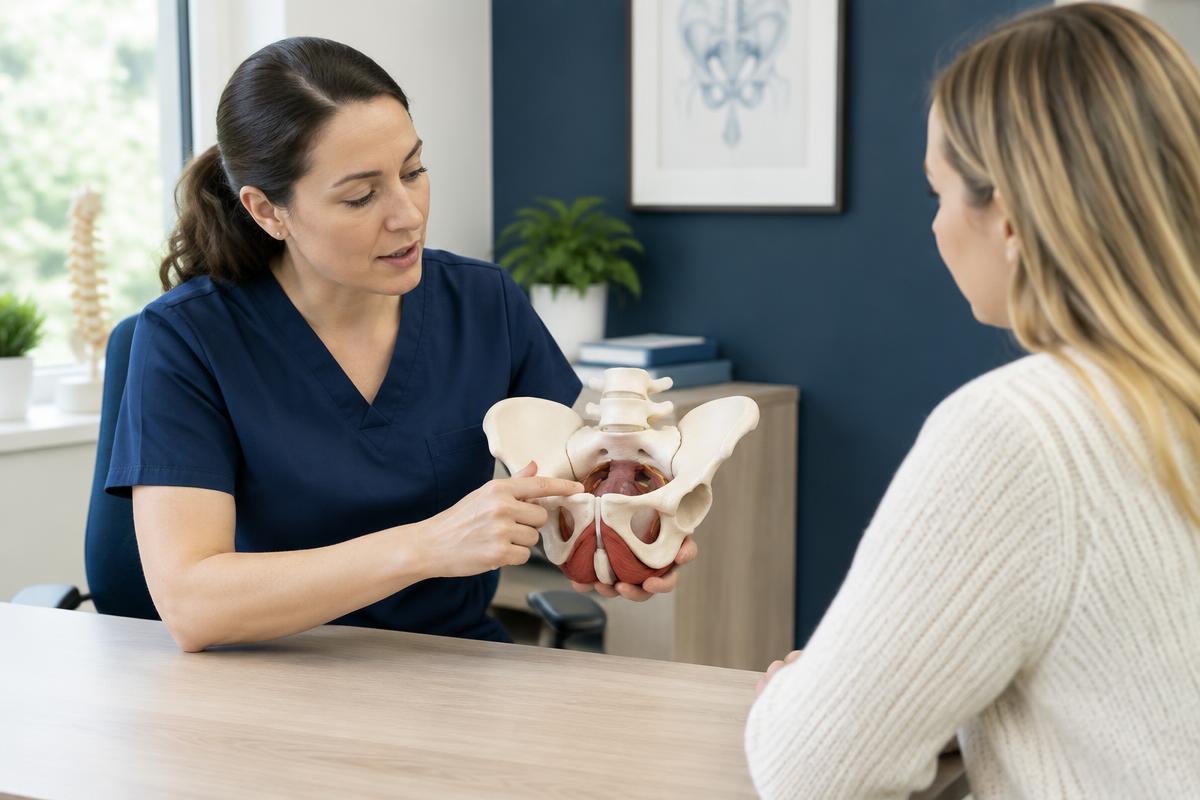
Pelvic organ prolapse means the bladder, uterus, or rectum has descended into the vaginal wall because the supporting tissue is not holding as it should. It usually feels like heaviness, pressure, a dragging ache by the end of the day, or the sensation of sitting on something. Sometimes there is a visible bulge.
Who should you actually see?
- A urogynaecologist or gynaecologist diagnoses and stages the prolapse, fits a pessary, and performs surgery when it is needed.
- A pelvic floor physical therapist treats the muscles, pressure management and daily habits that determine how much your prolapse bothers you — and how likely it is to progress.
- Most women do best seeing both. They answer different questions, and I coordinate with your physician rather than replacing them.
Stage does not equal symptoms
This surprises people. Women with stage 2 prolapse can be miserable and women with stage 3 can be barely bothered. What you feel depends heavily on how your pelvic floor supports the load and how you manage pressure through the day. That gap between anatomy and symptoms is exactly where physical therapy does its work.
What conservative treatment involves
- Pelvic floor muscle training, verified with real-time ultrasound imaging so the contraction is correct rather than a bear-down
- Pressure management — how you lift a toddler, a laundry basket, or a barbell without driving load downward
- Constipation care, because straining on the toilet is one of the strongest drivers of progression
- Positional and load strategies for your specific job and workouts, so you can keep exercising rather than giving it up
- Support and coordination with your physician about a pessary if that would help you stay active
The evidence here is solid: supervised pelvic floor muscle training reduces prolapse symptoms and can improve stage in mild to moderate cases. It is recommended as first-line care before surgery is considered.
And if you do need surgery
Some prolapse is surgical, and I will say so. Even then, doing this work before the operation and returning to it afterwards protects the repair — because the pressure habits that contributed the first time do not disappear because a surgeon fixed the anatomy.
A prolapse diagnosis is not a sentence to give up running, lifting, or your life. It is a reason to learn how to load your body properly.
If you are in North Jersey
Our clinic is in Upper Montclair, minutes from Montclair, Glen Ridge, Bloomfield, Verona, Cedar Grove and the rest of Essex County. Every visit is a full hour, one-on-one with me, and internal assessment is always optional.